Real
World Tests: I
fished the Shimano
Antares A70 on a
number of rods over
the last few months,
but mostly on the
G.Loomis Conquest,
Megabass Destroyer,
and Dobyns Xtasy
series rods, as I
tried to pair the
reel with similarly
positioned flagship
class rods. I
targeted largemouth
and spotted bass
using a variety of
lure types,
including reaction
baits, swimbaits,
and mostly plastics
with light
fluorocarbon lines.
I didn’t test the
reel with braid, and
all of the tests
were conducted with
Seaguar Tatsu 10lb.
or Hi-Seas 100%
Fluorocarbon 6 to
10lb. line. Since
the reel’s frame is
made out of
magnesium I was
curious about
durability but
wanted to get this
review completed
quickly, and will
continue to monitor
and report on the
reel’s long term
performance, as I
continue to fish it
in both fresh and
brackish water
conditions.
Real
World Tests: I
fished the Shimano
Antares A70 on a
number of rods over
the last few months,
but mostly on the
G.Loomis Conquest,
Megabass Destroyer,
and Dobyns Xtasy
series rods, as I
tried to pair the
reel with similarly
positioned flagship
class rods. I
targeted largemouth
and spotted bass
using a variety of
lure types,
including reaction
baits, swimbaits,
and mostly plastics
with light
fluorocarbon lines.
I didn’t test the
reel with braid, and
all of the tests
were conducted with
Seaguar Tatsu 10lb.
or Hi-Seas 100%
Fluorocarbon 6 to
10lb. line. Since
the reel’s frame is
made out of
magnesium I was
curious about
durability but
wanted to get this
review completed
quickly, and will
continue to monitor
and report on the
reel’s long term
performance, as I
continue to fish it
in both fresh and
brackish water
conditions.

The reel's SVS
infinity braking is
adjusted with an
easy to access
external dial
Casting:
While magnesium
reels offer reduced
weight and overall
improved ergonomics
they sometimes can
feel somewhat
“hollow” when
casting and
retrieving. The new
Antares mitigates
this with a number
of features
including
reinforcement of the
main magnesium body
with those aluminum
side plates for
better isolation,
and a new MGIII
spool design that is
designed to be both
lighter and reduce
vibration. The
result is a reel
that strikes a fine
balance between
weight, casting
performance, and
overall refinement.

The dial can be
infinitely adjusted
for fine tuning the
centrifugal cast
system. No DC system
here.
The first few times
I casted the new
Antares I noticed
two things right
away. First, how
effortless the reel
was to cast, and
second how well it
was able to cast
very light baits.
The reel’s overall
maximum casting
distance is
impressive, and this
reel is able to
rival the max
casting distance and
short range
precision of DC
equipped reels.

One of the biggest
differentiators is
the new MGL III
spool
Line seems to peel
off quickly, and
effortlessly, which
is primarily due to
the MGL III’s spool
size, and weight.
The Antares spool is
slightly larger in
diameter than reels
like the Curado or
Metanium and this
taller spool allows
more line to come
off per revolution
of the spool. This
means anglers can
cast further with
the same energy.
Also with a tall and
shallow spool, you
move the weight
outboard which also
enhances casting
distance.

A look at the taller
MGL III spool and
attached brake
weights
The previous Antares
and Conquest model
reels use this same
design philosophy,
and even though the
difference between
the spools may seem
minimal (34mm
diameter compared to
32mm for the MET and
CU models), there is
an effect to
performance and
handling. In
addition to these
dimensional tweaks
Shimano sought to
achieve incremental
improvements in the
MGL spool design by
reducing vibration.

The MGL III spool
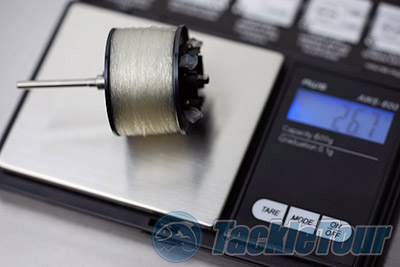
weighs only 13.2
grams
MGLIII Spools were
designed to be
lighter and have
less vibration than
the previous
versions, really
taking advantage of
SilentTune which
reduces bearing
vibration by
isolating the
bearing holding the
spool. By minimizing
even minute amounts
of vibration,
reduced inertia is
needed to cast
lightweight baits,
and less vibration
also increases the
potential for
improved casting
distance.
How refined is this
new design? Dan
Thorburn of Shimano
explained that the
balance is so
critical on these
spools that they do
not advise using
tape as a base for
braided line, and
instead suggest
using a few feet of
mono backing to
splice the braided
line in.