A look inside the design of the
Quantum Aruba PTs
(continued)

 The
Bearings:
Shimano has A-RB bearings and Daiwa has CRBB bearings. Quantum's answer is their
proprietary super bearings made out of Nitrogen-Alloy. The Aruba PTs houses five
Nitrogen-Alloy PT bearings and although their exact composition is a classified, we
were told that they are much more expensive and are ten times more corrosion
resistant than standard stainless steel bearings.
The
Bearings:
Shimano has A-RB bearings and Daiwa has CRBB bearings. Quantum's answer is their
proprietary super bearings made out of Nitrogen-Alloy. The Aruba PTs houses five
Nitrogen-Alloy PT bearings and although their exact composition is a classified, we
were told that they are much more expensive and are ten times more corrosion
resistant than standard stainless steel bearings.

A sealed
Nitrogen-Alloy PT bearing that's ten times more corrosion resistant
Here’s what ChuckE,
TackleTour’s resident bearing expert, had to say about Quantum’s Nitrogen-Alloy
PT bearings:
“High nitrogen alloyed
stainless steel has been around for a while. But the most popular alloy, SV-30,
was commercially introduced in the mid 1980's. This alloy is noted for good
resistance to salt water corrosion, while still providing similar wear and
hardness of 440C Stainless, 440D Stainless and 42100 Steels. Early in 2000 GRW (a
German bearing manufacturer), began to use SV-30 for the races of ceramic hybrid
bearings, primarily for high temperature and corrosive environments. The
bearings were initially used in turbochargers, vacuum sealing pumps, etc. but
have since expanded into medical, food, aerospace and other applications. In
some situations SV-30 does not resist wear quite as well as 440C, 440D or 42100,
although it does resist Chloride related corrosion better than these others. On
one hand I would have to say they will likely resist corrosion better than
a conventional stainless bearings but without any detailed information from the
bearing manufacturer we can only take a stab at the quality.”

Lever drag
system provides accurate force

Indicators for
Free, Strike, and Full drag settings
The Drag:
Every component of a reel must work as one. If one part fails, it can halt
operation. The drag must function flawlessly especially in a conventional reel
when trolling for huge fish. The Quantum Aruba PTs saltwater reel employs a dual
carbon drag system. Two large carbon-fiber disks produce up to 45 pounds of
pressure at the striking position and up to 60 pounds in the full-on position.
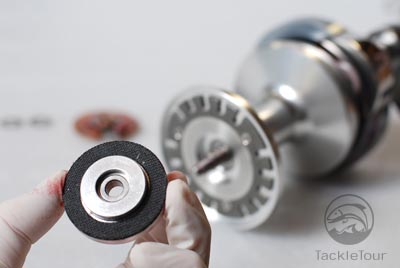
The Aruba PTs
uses carbon fiber discs
After taking apart the
reel to inspect the drag system, I noticed the washer on the handle side is
larger than the carbon-fiber disk on the other end. This doesn’t cause any
issues because the system applies equal pressure to both sides even though the
disks are not the same dimension.

The larger
drag washer is on the handle side
Though we were unable to
push the reel’s drag to the limits of 60 pounds of force, we did conduct a few
tests in our lab to see just what kind of pressure we were able to achieve. Some
companies actually test out their drags by hooking it up to a car and then
letting it rip. We didn’t quite go that far as tests like those are rather
destructive, and we do want to see what this reel will do in the real world
before we unnecessarily stress the product. Below is a table of drag settings noting the following metrics:
start up pressure (the force needed to get the drag moving); drag pressure (the
maintainable force of the drag once in motion); smoothness (the quality of
rotation once the drag is in motion under a constant pull).
|
Start Pressure (lb) |
Drag Pressure (lb) |
Smoothness |
|
7 |
5.5 |
Smooth |
|
12 |
11.1 |
Smooth |
|
20.5 |
19.2 |
Smooth |
|
27 |
25 |
Smooth |
|
35 |
32.4 |
Smooth |

The gear
that's used to set the drag pressure from the non-handle side
Tool-less maintenance and conclusion